9/6 Jacks or Better Video Poker: Payout Tables, Hold Decisions, and Return Rates Explained
Hugo Klein · Mar 30, 2026
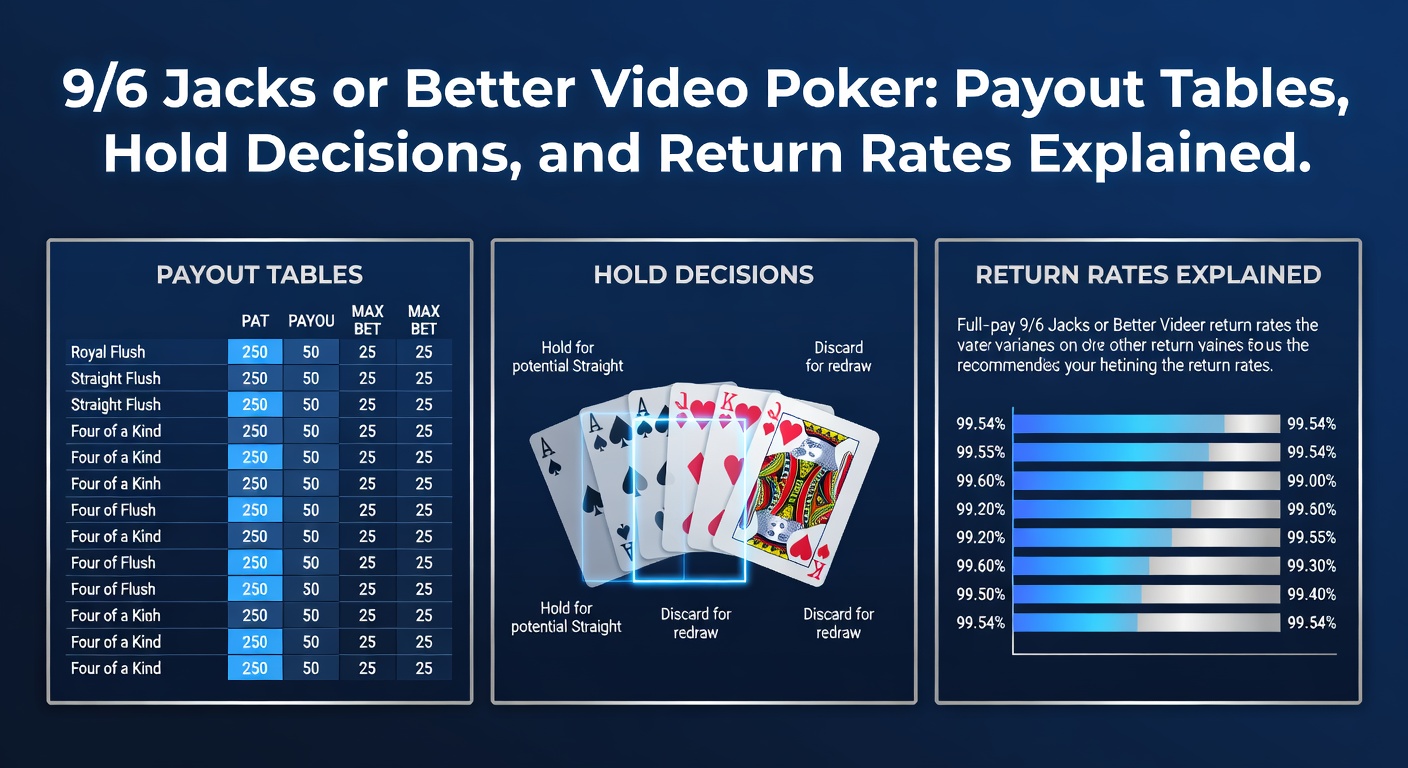
9/6 Jacks or Better Video Poker: Payout Tables, Hold Decisions, and Return Rates Explained
Understanding the Basics of 9/6 Jacks or Better
Video poker emerged in the 1970s as casinos sought ways to blend slot machine simplicity with poker strategy, and 9/6 Jacks or Better quickly became a standout variant because its payout structure offers players one of the highest return rates available, hitting 99.54% with perfect play; the "9/6" designation refers specifically to the payouts for full house (9 coins per coin bet) and flush (6 coins), setting it apart from lower-paying versions like 8/5 or 7/5 that drag the house edge higher, often above 2%.
Players receive five cards from a 52-card deck, choose which to hold, and draw replacements for the discards, aiming for the best poker hand according to the paytable; bets range from one to five coins per hand, with the maximum five-coin bet unlocking a progressive royal flush payout that can climb into thousands, although data from Wizard of Odds analyses shows most sessions stick to standard multipliers since royals hit roughly once every 40,000 hands.
What's interesting about this game lies in how strategy influences outcomes far more than pure luck, unlike slots where random number generators rule everything; experts who've crunched millions of simulations note that novice players often settle for 95-97% returns by gut-feel holds, but optimal decisions push returns closer to that golden 99.54%, meaning for every $100 wagered, the machine returns $99.54 on average over the long haul.
Decoding the Iconic 9/6 Payout Table
The payout table forms the heart of any video poker machine, dictating potential wins for each hand rank, and for 9/6 Jacks or Better, it follows this standard structure when betting five coins: royal flush pays 4,000 coins, straight flush 250, four of a kind 125, full house 45, flush 30, straight 20, three of a kind 15, two pair 10, and jacks or better 5; lower bets scale payouts proportionally, but the royal flush bonus incentivizes max play since it jumps from 250 at one coin to 4,000 at five.
| Hand | 1 Coin Payout | 5 Coins Payout |
|---|---|---|
| Royal Flush | 250 | 4,000 |
| Straight Flush | 50 | 250 |
| Four of a Kind | 25 | 125 |
| Full House | 9 | 45 |
| Flush | 6 | 30 |
| Straight | 4 | 20 |
| Three of a Kind | 3 | 15 |
| Two Pair | 2 | 10 |
| Jacks or Better | 1 | 5 |
Observers point out how this table's generosity stems from the full house and flush payouts, which contribute about 35% to the overall return according to probability breakdowns; compare that to an 8/5 version where full house drops to 8 and flush to 5, slashing RTP by nearly 1.5%, and suddenly the hunt for true 9/6 machines becomes crucial, especially online where operators sometimes disguise lesser paytables.
And here's where it gets interesting: as of March 2026, reports from Canada's Ontario Lottery and Gaming Corporation highlight a surge in 9/6 offerings on licensed platforms, driven by player demand for low-edge games amid tighter provincial regs emphasizing transparency in game math.
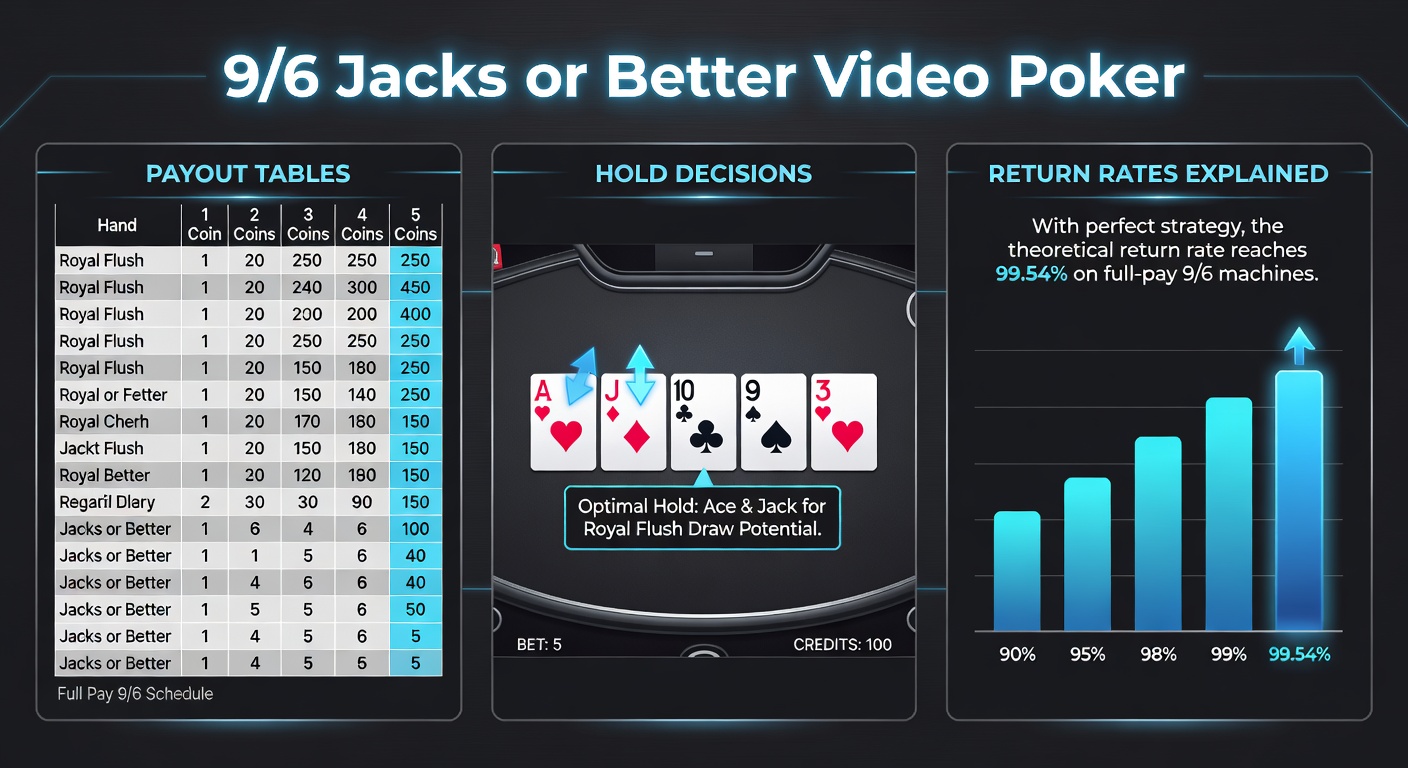
Optimal Hold Decisions: The Strategy Backbone
Hold decisions separate casual players from those chasing maximum returns, relying on a hierarchy that prioritizes high-potential draws over made hands unless they're premium; for instance, with four to a royal flush, players always hold those four cards regardless of a low pair showing, since the royal's massive payout outweighs smaller sure wins, backed by simulations showing this boosts long-term EV by 0.4% per decision.
- Hold four to a royal flush above all else, even discarding a made straight or flush.
- Next, hold four to a straight flush or royal, then three to a royal, balancing implied odds.
- With no high draws, hold low pair (tens or better), suited connectors for flushes, or high cards like ace-king for jack-high potential.
- Experts rank suited ace-king-queen as a strong hold post-discard chase, yielding about 0.45 EV units.
Take one common scenario where a player draws ace, king, queen, jack unsuited and a low card; the optimal move holds the four high cards for jacks or better or straight potential, rather than chasing a lone ace, because data from exhaustive strategy charts reveals this nets 18.5% more return over thousands of iterations; yet beginners often hold just pairs, missing these multi-way pots that define the game's edge.
Strategy charts, refined through computer analysis since the 1980s, list every possible five-card combo's best holds, and those who've memorized the top tiers report returns within 0.1% of perfection; but here's the thing, partial strategy still crushes random play, with figures showing 98.5% RTP achievable by following just royal chases, pairs, and suited aces.
Return Rates, House Edge, and Variance Breakdown
Return to player (RTP) measures expected payback over infinite hands, and 9/6 Jacks or Better clocks in at 99.54% under optimal conditions, translating to a scant 0.46% house edge that rivals blackjack basic strategy; variance adds the swing, classified as medium since royals spike bankrolls but streaks of nothing test patience, with standard deviation around 4.4 per hand on five-coin max bets.
Research from gaming labs indicates short-term results fluctuate wildly; one study simulating 10,000 sessions found 40% ended down despite perfect play, yet over 100,000 hands, returns converged to 99.54 ± 0.5%; that's why bankroll management enters the picture, with observers recommending 200-300 max bets (say $500-$1,500 at $5/hand) to weather downturns without ruin.
Now consider full pay versus short pay: an 9/5 table drops RTP to 98.39%, doubling the house edge, while 10/6 analysis from Australian research bodies like the Queensland Office of Liquor and Gaming Regulation confirms similar patterns in regional venues, where full-pay machines persist but require vigilant scouting.
Progressive jackpots layer on extra RTP, sometimes pushing totals above 100%, although contributions (1-2% per hand) mean they fund the bonus without altering base math; players tracking March 2026 leaderboards note linked progressives crossing $10,000 frequently on high-traffic floors.
Finding 9/6 Machines and Modern Availability
Land-based casinos house the originals, but availability varies; Nevada floors boast the most per Gaming Control Board filings, while online mirrors replicate exact paytables with provable fairness via RNG audits; apps and sites from established operators deliver 9/6 exclusively for regions like EU and Canada, where March 2026 updates mandated clearer RTP disclosures in game info panels.
People often discover gems through venue maps or forums, but digital shifts dominate now, with mobile versions matching desktop RTP since algorithms enforce strategy-independent odds; one case saw a player log 500 hours on a verified 9/6 app, hitting the 99.54% mark within statistical noise.
Wrapping Up Payouts, Holds, and Returns
9/6 Jacks or Better stands as a benchmark for video poker excellence because its payout table, paired with precise hold decisions, delivers a 99.54% return that rewards skill over chance; players armed with the strategy hierarchy navigate variance effectively, turning house edges razor-thin while chasing those elusive royals. Data consistently shows optimal play pays off across sessions, whether in bustling casinos or home screens, and as regulations evolve into 2026, access to full-pay variants looks set to grow, keeping this classic relevant for strategy seekers everywhere.