Analyzing Expected Values in Craps Side Bets with Probability Tables
Noah Weber · Aug 22, 2026
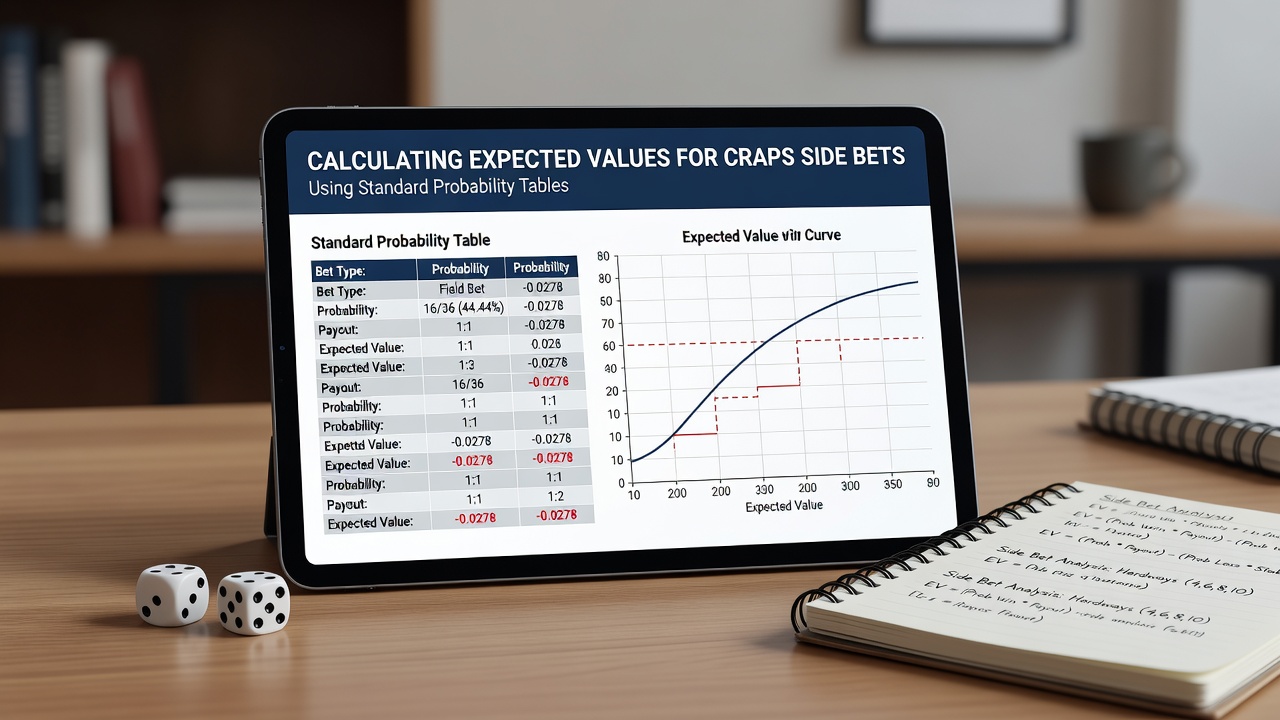
Analyzing Expected Values in Craps Side Bets with Probability Tables
Calculating expected values for craps side bets starts with reference to standard probability tables that map every possible dice combination and its occurrence rate across 36 total outcomes, and these tables serve as the foundation for determining long-term returns on wagers like Any 7, Any Craps, and Hardways. Observers note that side bets differ from core line bets because their payouts often carry higher house edges, yet the same probability framework applies across the board.
Core Structure of Craps Probability Tables
Standard probability tables list each dice total from 2 through 12 along with the exact number of ways it can appear, so a total of 7 shows up six times while totals like 2 and 12 appear only once each, and those frequencies convert directly into percentages such as 16.67 percent for seven and 2.78 percent for either extreme. Analysts apply these figures when evaluating side bets that pay on specific totals or combinations, which allows precise computation without relying on estimates.
Applying the Expected Value Formula
The expected value formula multiplies each possible outcome by its probability, sums the results, and subtracts the initial wager amount to reveal the average return per bet over many trials, and this approach works uniformly for all side bets once the payout odds and probability table entries are aligned. Researchers discovered that converting probabilities into decimals simplifies the arithmetic, so a 5-to-1 payout on a 13.89 percent chance outcome yields an expected value that accounts for both wins and the more frequent losses.
Example Calculation for the Any 7 Side Bet
Any 7 pays 4 to 1 and wins only when a seven appears, which occurs on six of thirty-six rolls, therefore the calculation runs as follows: (6/36 times 5) plus (30/36 times negative 1) equals negative 0.167, indicating a house edge of 16.67 percent according to repeated verification against probability tables. This result remains constant regardless of table layout variations because the underlying frequencies stay fixed by the physics of two fair dice.
Additional Side Bet Evaluations
Any Craps pays 7 to 1 on totals of 2, 3, or 12, which together account for four outcomes, and the expected value computation produces a house edge near 11.11 percent once probabilities and payouts combine in the standard formula. Hardway bets on doubles like 4 or 10 carry even lower win probabilities of 2.78 percent each while paying 7 to 1, resulting in house edges that exceed 11 percent and demonstrate why probability tables remain essential for accurate assessment.
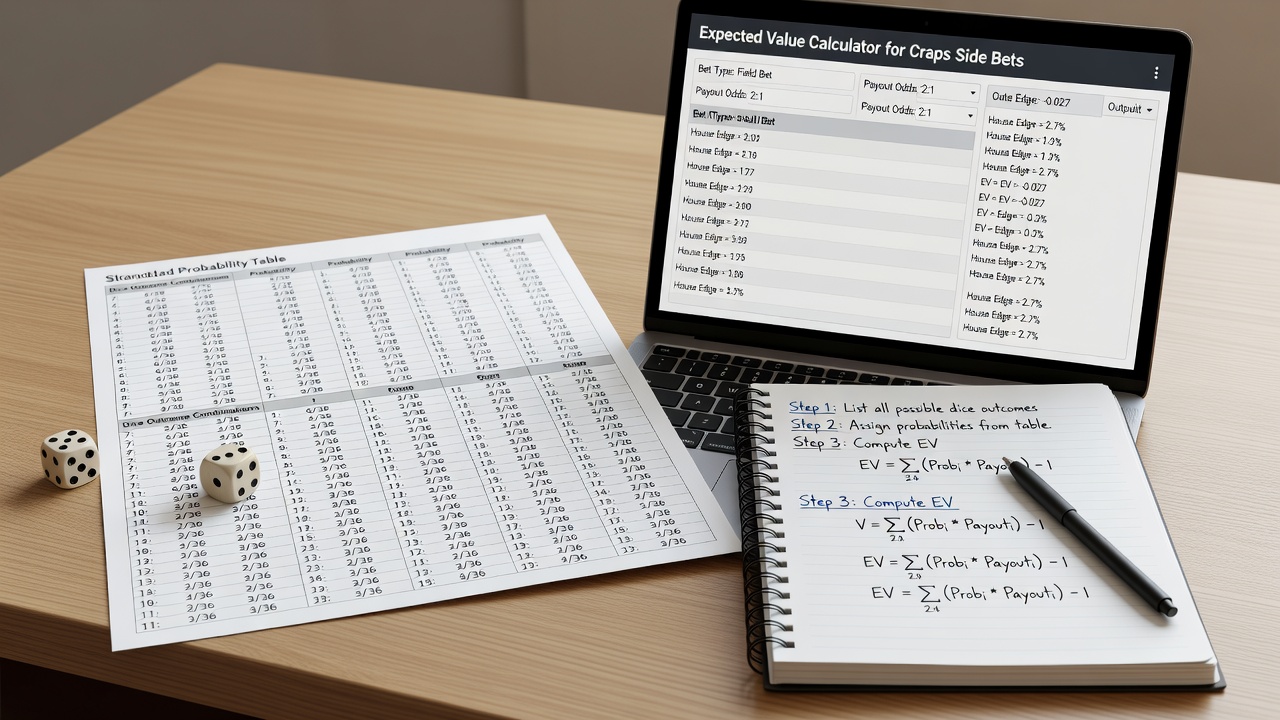
Big 6 and Big 8 side bets pay even money yet win only on six or eight respectively, each occurring five ways, so their expected values sit at negative 9.09 percent, and these figures emerge directly from the same tables used for more complex wagers. Data from industry reports shows consistent application of these tables across casino floors, with no regional variation in the core probabilities themselves.
Role of Updated Tables in Modern Analysis
Analyses updated through August 2026 continue to rely on the identical 36-outcome framework because dice probabilities do not change, although some digital platforms now present interactive versions that highlight side bet edges instantly. Those who've studied this know that cross-referencing multiple table formats confirms the same expected values, which supports uniform strategy discussions regardless of venue type.
According to findings referenced by the American Gaming Association, probability tables underpin all published house edge data for table games, while additional verification appears in reports from the Alcohol and Gaming Commission of Ontario that examine North American gaming standards. These sources align on the arithmetic because they draw from the same foundational frequencies.
Conclusion
Expected value calculations for craps side bets rest entirely on accurate probability tables, and consistent application of the formula across common wagers reveals house edges that range from roughly 9 percent to over 16 percent depending on the specific bet. Observers note that familiarity with these tables enables precise comparison of payout structures without requiring real-time observation, and the method extends naturally to any new side bet introduced on casino floors.