Core Probability Structures Linking Roulette Craps and Sic Bo
Hugo Klein · Jun 6, 2026

Core Probability Structures Linking Roulette Craps and Sic Bo
Probability calculations form the backbone of roulette craps and sic bo yet the underlying structures often overlap in unexpected ways according to analysts who track gaming mathematics. Each game relies on independent random events that produce fixed sets of outcomes and the payouts rarely align exactly with true mathematical probabilities which creates consistent statistical edges for operators.
Roulette operates through a wheel divided into numbered pockets where a ball lands after spins while craps uses two dice thrown across a table and sic bo employs three dice displayed in combinations and observers note that all three games draw from the same fundamental pool of combinatorial mathematics. Researchers at institutions studying random processes have mapped how these systems generate expected values and variance patterns that repeat across different formats.
Independent Events and Outcome Distributions
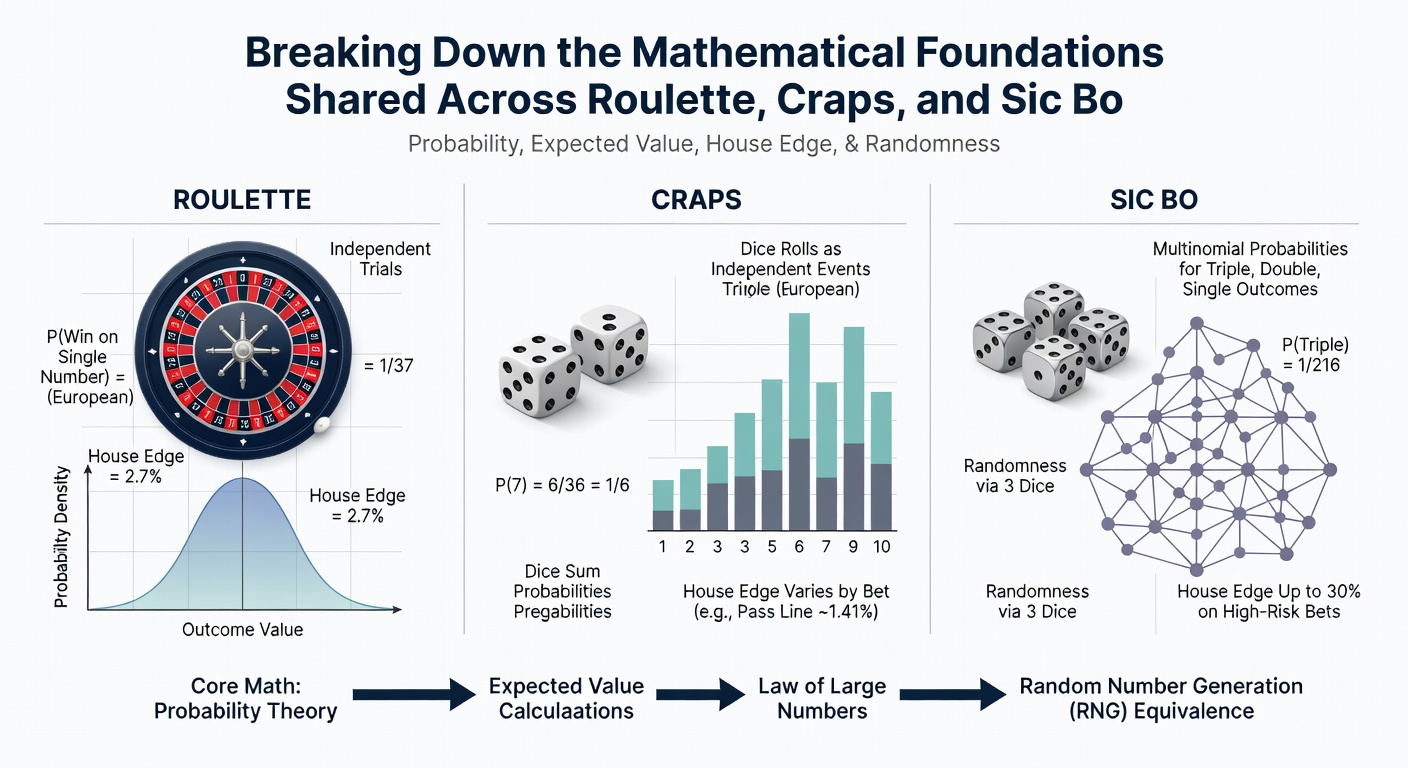
Every roll or spin in these games produces results independent of previous ones and this property allows mathematicians to apply the same formulas when calculating long term frequencies. In roulette each number carries an equal chance on a fair wheel while craps pass line bets depend on the distribution of sums from two dice and sic bo wagers hinge on frequencies of specific three dice patterns. Studies published through academic channels confirm that binomial and multinomial distributions describe the core mechanics in all three cases.
Data collected over millions of trials reveals that the law of large numbers governs player results in each game and short term fluctuations give way to predictable averages as volume increases. Gaming research groups have documented how variance behaves similarly whether measured across roulette columns or craps point numbers or sic bo total sums and this consistency helps explain why bankroll management formulas transfer between titles without major adjustments.
House Edge Calculations and Payout Structures
The mathematical advantage held by the house stems from payout ratios that fall short of true odds and this gap appears uniformly across roulette craps and sic bo. European roulette wheels with a single zero yield a house edge of 2.7 percent on most bets while American wheels with both zero and double zero push the edge to 5.26 percent according to figures released by regulatory bodies in multiple jurisdictions. Craps pass line bets carry an edge of 1.41 percent and certain sic bo combination bets range from 2.78 percent up to higher figures depending on the specific wager selected.
Analysts comparing these edges find that players encounter similar decision points where choosing lower edge options improves expected return over time. Reports from North American gaming oversight agencies show that education on these percentages correlates wth changes in average bet selection and similar patterns emerge in European and Australian markets where operators publish standardized return to player percentages.
Variance Risk and Session Modeling
Volatility measures how far actual results deviate from expected values and this metric follows comparable trajectories in all three games. Roulette even money bets produce lower variance than inside number wagers while craps place bets on six or eight show different swing patterns than hardway bets and sic bo single number bets on one die face generate steadier outcomes than triple specific number bets. Quantitative models developed by probability researchers demonstrate that standard deviation formulas remain interchangeable once bet size and edge are accounted for.
Simulation software used by industry analysts in June 2026 incorporated updated datasets from international operators and the results highlighted how session length interacts with variance in identical ways whether applied to a roulette wheel or a sic bo table. These models help illustrate why bankroll requirements scale predictably across titles when players maintain consistent unit sizes.
Combinatorial Foundations and Randomness Testing
Combinatorics provides the counting tools that underpin outcome probabilities and the same counting principles apply when enumerating roulette pocket arrangements craps dice permutations and sic bo triple combinations. Permutation formulas calculate total possible results while combination formulas determine favorable cases and this shared methodology allows direct comparison of game fairness across platforms. Testing laboratories certified by various international standards apply the same statistical tests for randomness to wheels and dice machines regardless of the specific game.
Regulatory frameworks in Canada and Australia require operators to submit periodic randomness audits that reference the same underlying statistical thresholds and these requirements ensure that physical and electronic versions maintain equivalent distribution properties. University affiliated research teams have published papers demonstrating that deviations from expected frequencies follow chi square distributions in each game type when sample sizes reach sufficient scale.
Conclusion
The mathematical connections between roulette craps and sic bo rest on shared principles of independence combinatorial counting and edge calculation and these elements produce consistent patterns observable across extensive datasets. Observers tracking industry developments note that updated simulation tools released around June 2026 continue to validate these overlaps while regulatory bodies in multiple regions maintain uniform testing standards that reinforce the underlying structures. Players examining these foundations gain clearer insight into how probability governs outcomes across different table formats without reliance on game specific intuition alone.