Decoding Pay Table Configurations Across Video Poker Games and Their Influence on Strategies at Various Casino Locations
Zara Ludwig · Jun 23, 2026
Decoding Pay Table Configurations Across Video Poker Games and Their Influence on Strategies at Various Casino Locations
Video poker variants rely on structured pay tables that list payouts for each winning hand combination, and these structures directly determine optimal play decisions at every step of a round. Players examine the return percentages tied to specific combinations like royal flushes, four of a kinds, and full houses while adjusting their holding patterns accordingly. Research from the University of Nevada shows that pay tables with higher royal flush rewards encourage more aggressive draws toward that hand even when intermediate pairs appear, whereas tighter tables push participants toward safer holds that lock in smaller but more frequent returns.
Core Elements of Pay Table Design in Video Poker
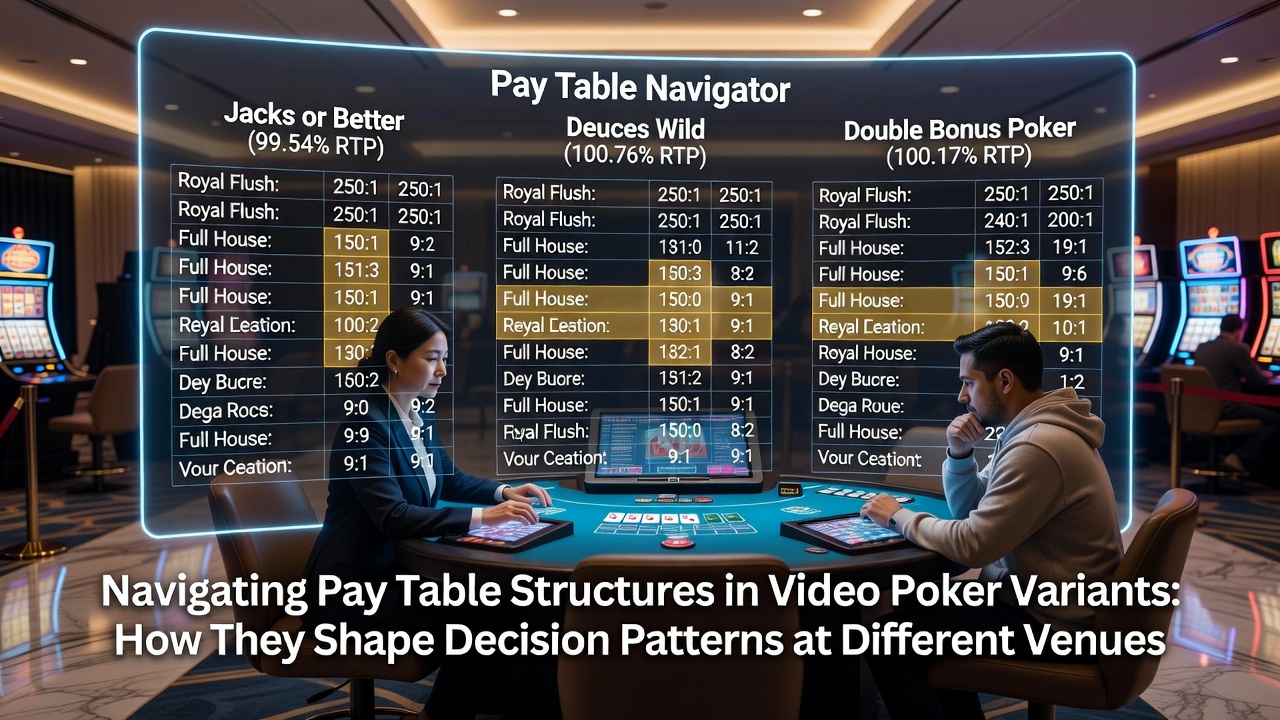
Each video poker pay table specifies credits awarded for hands ranging from high pairs up to the royal flush, and these values shift across variants such as Jacks or Better, Deuces Wild, and Double Double Bonus Poker. Observers note that a standard 9/6 Jacks or Better table returns 99.54 percent when played with perfect strategy, yet a 8/5 version drops that figure to 97.3 percent, which alters discard choices when players weigh the odds of completing straights versus securing three of a kinds. Data from the Nevada Gaming Control Board indicates that casinos in regulated markets publish these tables clearly on machine screens, allowing participants to compare options before committing credits.
Pay table rows typically list payouts for one coin through five coins played, and the jump in royal flush rewards at the five-coin level creates an incentive to max bet in many variants. Those who've studied machine behavior find that this structure leads to consistent max-coin play patterns at venues where progressive jackpots attach to royal flushes, because the incremental payout outweighs the risk of lower per-hand returns on lesser combinations.
Variant-Specific Pay Tables and Resulting Decision Shifts
Jacks or Better tables emphasize pair thresholds and straight-flush values that guide players to hold any pair while discarding single high cards in certain configurations. Deuces Wild variants introduce wild card mechanics that reshape holding rules, since a single deuce can complete multiple hand types and tables often boost payouts for five of a kinds or wild royals. Studies reveal that players switch from conservative pair retention to more exploratory discards when wild cards appear frequently on the pay table, because the potential for higher-tier wins justifies the risk.
Bonus Poker and Double Double Bonus Poker add multipliers for specific four-of-a-kind hands, and these extras change discard priorities when four cards to a flush compete with three cards toward a bonus four. Participants at different locations adapt by tracking the exact bonus triggers listed on each machine, which leads to venue-specific patterns where one casino's bonus-heavy tables attract more selective holding while another site's standard tables produce broader draw attempts.

Venue Differences in Table Availability and Player Adaptation
Casinos in Las Vegas often feature a wider range of pay table options on the floor compared with regional properties in other states, and this variety prompts travelers to adjust strategies upon arrival. Figures from industry reports show that properties competing for high-volume play install more 9/6 and 10/7 tables during peak seasons, which in turn shifts decision patterns toward riskier draws as players chase the improved returns. Those monitoring machine usage note that the same players who lock in pairs at tighter tables elsewhere begin discarding them more readily when better payouts appear.
Online platforms and land-based venues in markets outside Nevada display pay tables through digital interfaces that update in real time, and this flexibility allows operators to rotate configurations based on player traffic. Research indicates that June 2026 saw several major operators introduce seasonal pay table promotions tied to video poker tournaments, which temporarily altered holding patterns as participants chased enhanced royal and straight-flush rewards during event windows. The result appears in aggregated play data where discard frequencies for flush draws increase measurably during those periods.
Strategy Adjustments Driven by Pay Table Variations
Optimal strategy charts exist for each pay table variant, and these charts list precise actions for every five-card starting combination. Players consult printed or digital versions while seated, and the differences between charts become most apparent when borderline decisions arise, such as whether to hold a low pair or chase a three-card royal. Data shows that adherence to the correct chart for the displayed table maintains the published return percentage, whereas using an incorrect chart from another variant reduces expected value by several percentage points over extended sessions.
Venues that cluster machines with similar pay tables create environments where players develop muscle memory for consistent decisions, yet those who move between banks with divergent structures must pause to recheck values. Experts have observed that this movement between table types produces noticeable pauses in play rhythm at larger properties, where participants verify payouts before committing to each hand.
Conclusion
Pay table structures in video poker variants establish the mathematical foundation that guides every holding and discard choice, and these structures vary systematically across game types and casino locations. Players who examine the listed payouts before each session align their decisions with the actual return percentages available, which produces measurable differences in hand patterns at properties featuring 9/6 versus 8/5 tables or standard versus bonus-enhanced variants. Regulatory records and academic analyses confirm that access to accurate pay table information remains the primary factor shaping consistent strategy application across all venues.