Dice Probability Patterns: Linking Sic Bo Outcomes to Craps Strategies and Video Poker Payouts
Hugo Klein · Jun 2, 2026

Dice Probability Patterns: Linking Sic Bo Outcomes to Craps Strategies and Video Poker Payouts
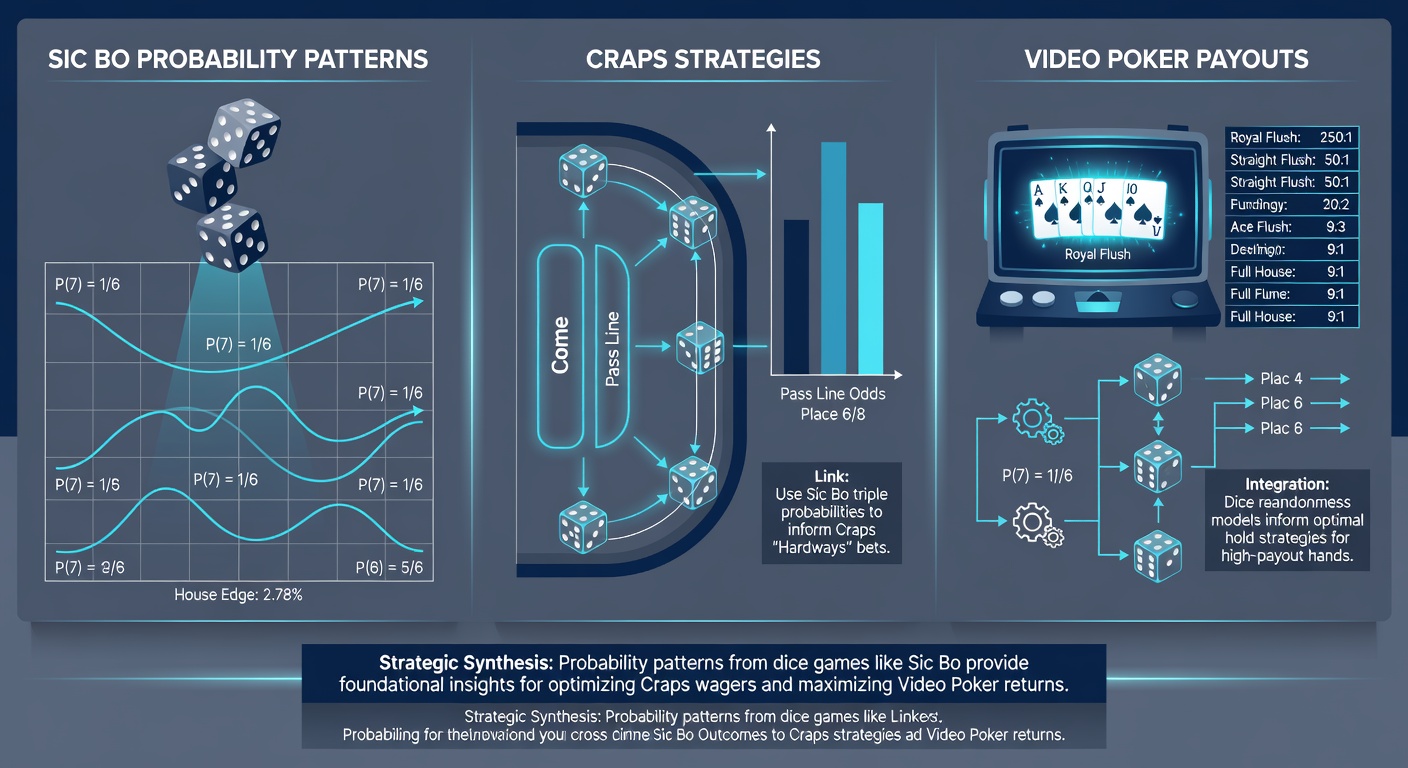
Three-dice combinations in Sic Bo create probability distributions that overlap with the two-dice mechanics found in craps, and observers note how these shared numerical foundations extend into payout structures seen across video poker variants. Data from gaming regulators shows that the 216 possible outcomes with three fair dice produce specific frequencies for totals, doubles, and triples, while craps relies on 36 two-dice permutations that determine pass-line resolutions and point establishments. Analysts track these frequencies because they influence bet selections in both table games, and the same mathematical ratios appear when video poker machines calculate expected returns based on card combinations that mirror dice-like independence.
Core Probability Structures Across Dice Games
Each roll in Sic Bo draws from 216 equally likely results, which means a specific triple such as three sixes occurs once while any total of seven appears in fifteen distinct ways. Craps players encounter parallel distributions because the come-out roll favors seven and eleven yet restricts point numbers like four and ten to three combinations each. Researchers at institutions studying random processes confirm that these counts remain constant regardless of prior rolls, and this independence allows strategies in craps to incorporate odds bets that reduce house edge when placed behind established points. Sic Bo bettors similarly select big or small wagers covering totals from four through ten or twelve through seventeen, each carrying fifteen winning combinations out of 216.
Transferring Patterns to Craps Decision Making
Players who examine Sic Bo outcome tallies often apply the same frequency awareness when choosing craps wagers such as place bets on six or eight, which carry five ways to win against the 36 total possibilities. The vig charged on buy bets for four and ten alters the effective return in ways comparable to the commission structures on certain Sic Bo triple bets, and reports from the Nevada Gaming Control Board indicate consistent player preference for lower-edge options once these ratios become clear. During sessions in June 2026, tables at major properties continued to display these probability alignments through digital displays that list historical hit rates, allowing observers to verify that the underlying 36-permutation framework governs both games without deviation.
Extending Numerical Ratios into Video Poker Calculations
Video poker payout tables reward specific hand rankings according to fixed multiples of the initial wager, and the expected value calculations rely on combinatorial counts that parallel the enumeration of dice results. A standard 9/6 Jacks or Better machine returns 0.995 when optimal holds are followed, according to figures released by the New Jersey Division of Gaming Enforcement, because the 52-card deck yields precise frequencies for pairs, straights, and flushes that function like the fixed outcome sets in three-dice Sic Bo. Observers note that the decision trees used in video poker strategy charts mirror the conditional betting adjustments made after a point is established in craps, where subsequent rolls must hit the point before seven appears. Both systems reward recognition of remaining possibilities once initial results narrow the field.
Comparative House Edge and Return Data
Industry reports compiled by the American Gaming Association place the house edge on standard Sic Bo big and small bets at 2.78 percent, while pass-line bets in craps sit near 1.36 percent before odds are added. Video poker variants can drop below one percent when full-pay tables are located, and these differences arise directly from the payout multiples assigned to rarer outcomes such as all-triples in Sic Bo or royal flushes in poker. Analysts compare these edges by converting each game’s outcome counts into equivalent percentages, revealing that the 216-result and 36-result matrices produce predictable long-term returns once volume increases. Data collected across multiple jurisdictions shows that players who track these ratios adjust wager sizes and selections in patterns that remain consistent from one venue to another.
Conclusion
The numerical linkages among Sic Bo, craps, and video poker rest on countable outcome sets that generate stable probabilities across independent trials. Regulatory summaries and academic enumerations continue to document these shared foundations, and the resulting strategy adjustments appear in player behavior at tables and machines alike. As gaming operations expand in 2026, the same probability patterns remain the basis for informed selections in each format.