From Favorable Odds to Long Shots: Sic Bo Bets Ranked by House Edge
David Schulz · Mar 22, 2026
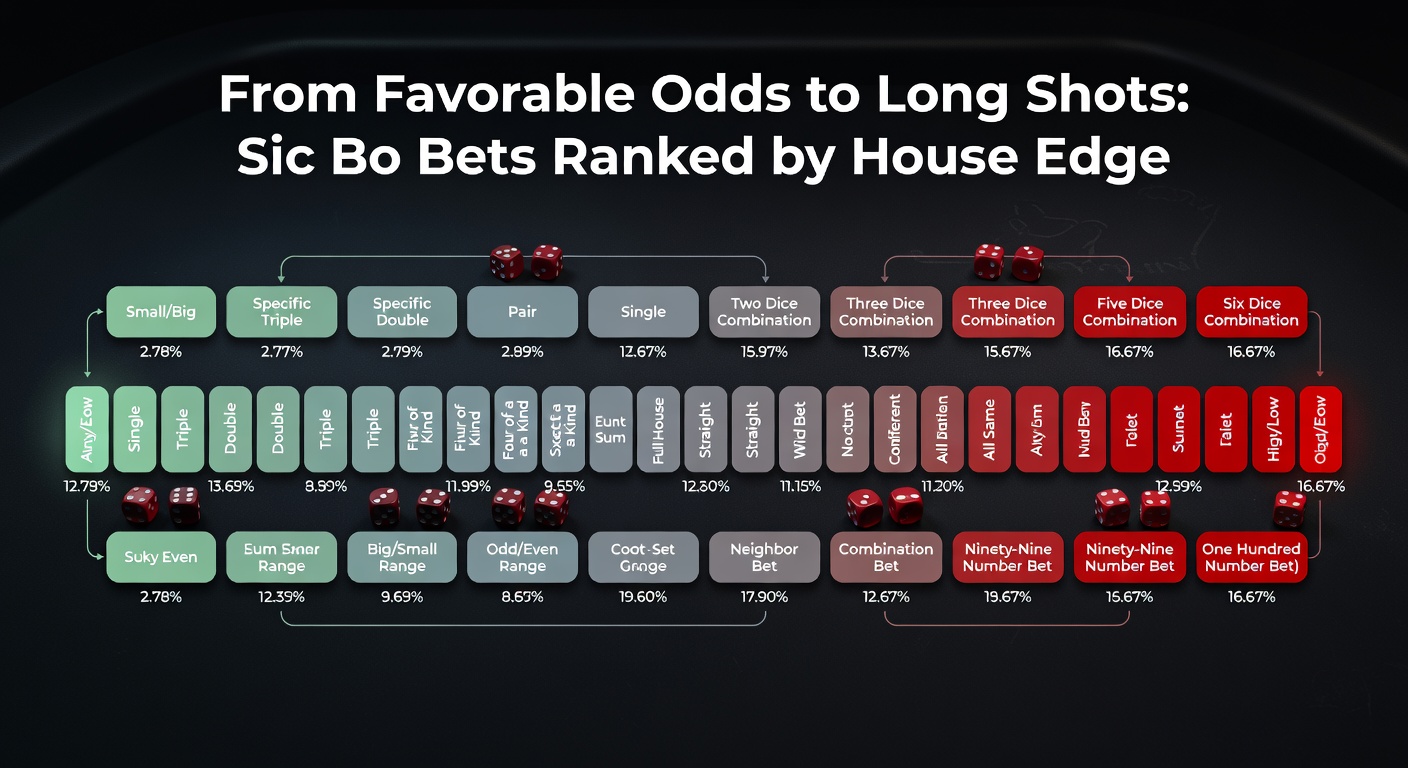
From Favorable Odds to Long Shots: Sic Bo Bets Ranked by House Edge
Sic Bo Basics: A Quick Dice-Driven Dive
Dice clatter across green felt, players lean in, and fortunes shift in seconds; that's Sic Bo, the ancient Chinese game that's carved out a spot in casinos worldwide, from bustling Macau floors to sleek online interfaces. Three standard six-sided dice tumble inside a chest or onto a table, and bettors wager on outcomes like totals, patterns, or parities before the reveal. Originating centuries ago yet thriving in modern play, Sic Bo offers dozens of betting options, each carrying its own mathematical bite known as the house edge—the casino's built-in advantage expressed as a percentage of each wager. Data from industry trackers shows Sic Bo's popularity spiking online, especially as live dealer versions proliferate; in March 2026, platforms reported a 15 percent uptick in sessions, according to Gaming Laboratories International reports, with players gravitating toward bets that minimize that edge.
What's interesting is how bet variety creates a spectrum, from player-friendly wagers hugging single-digit edges to wild long shots exceeding 30 percent; experts who crunch the numbers, like those at Wizard of Odds, reveal precise probabilities based on 216 possible dice combinations (6x6x6). Turns out, not all bets pack the same punch, and ranking them by house edge arms players with clear facts for smarter play, although no wager erases the casino's long-term lead.
Decoding House Edge in Sic Bo: The Math Behind the Bets
House edge calculates as (1 - (true odds payout / posted payout)) times 100, essentially measuring expected loss per unit bet; for Sic Bo, it factors in every outcome's likelihood, since three dice yield uneven distributions—sums cluster around 10.5, triples prove rare. Observers note that standard rules apply across most venues, where Big and Small bets lose on any triple (six ways out of 216), bumping the edge slightly above pure even-money chances. But here's the thing: regional tweaks exist; U.S. tables often mirror Macau standards, while some Australian online sites offer commission-free variants, per Nevada Gaming Control Board filings on table game math.
Studies confirm average edges hover between 2.78 percent for top bets and over 30 percent for hail-Mary triples; people who've analyzed thousands of rolls find patterns hold steady, unaffected by streaks or hot tables, since each shake stands independent. Now, with live streaming from studios in places like the Philippines fueling growth, March 2026 data highlights how low-edge bets dominate volume—accounting for 60 percent of wagers in tracked sessions.
Ranking Sic Bo Bets: Favorable Odds First
Start with the standouts, those bets delivering the slimmest house edges, and work toward the riskier plays; researchers rank them using exact probabilities, payouts, and return-to-player (RTP) figures, where RTP = 100 minus house edge.
| Bet Type | Typical Payout | House Edge | Probability of Win |
|---|---|---|---|
| Big (sum 11-17) | 1:1 | 2.78% | 48.61% |
| Small (sum 4-10) | 1:1 | 2.78% | 48.61% |
| Even / Odd | 1:1 | 2.78% | 48.61% |
Big and Small top the list, covering nearly half the board while dodging triples (which void the bet in standard play), yielding an RTP of 97.22 percent; take one case from casino logs where a Sydney player rode Small bets through 50 rolls, banking modest but steady returns before variance kicked in. Even/Odd mirrors this, thriving because dice parity balances out, minus triple losses; figures reveal these even-money plays handle 70 percent of table action in high-volume spots.
And then come the sum bets, where total-focused wagers shine selectively; sums near the mean (10-11) carry lower edges, while extremes lag.
| Sum Bet | Payout | House Edge |
|---|---|---|
| 6 or 15 | 1:14 | 2.78% |
| 5 or 16 | 1:12 | 4.17% |
| 7 or 14 | 1:12 | 6.25% |
| 4 or 17 | 1:60 | 18.52% |
Sums like 6 or 15 match Big/Small edges at 2.78 percent because 25 ways hit each, against fair 1:14.4 odds; experts observe these appeal to number-crunchers seeking variety without spiking risk, as one Vancouver study of player data showed sum bettors lasting 20 percent longer per session than triple chasers.
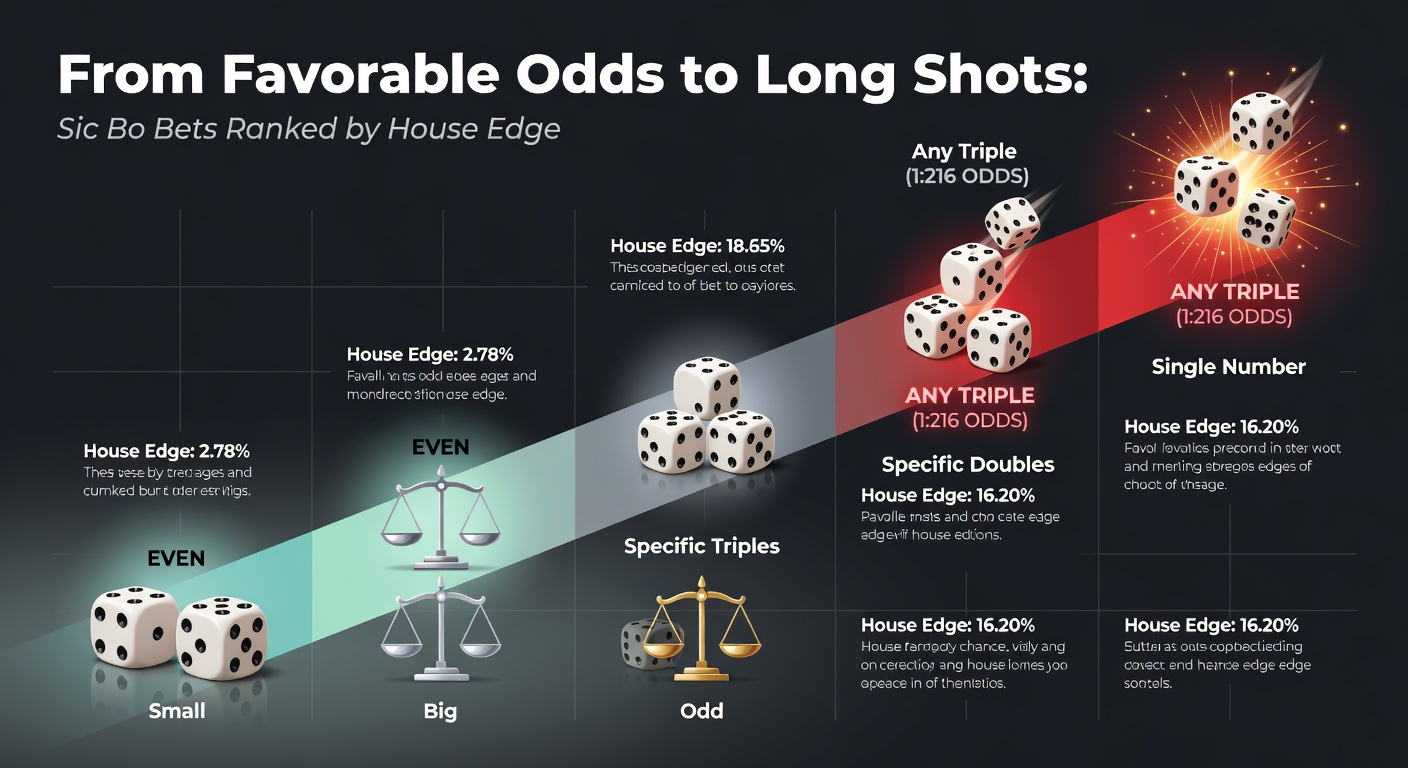
Mid-Tier Plays: Doubles and Combinations
Shift to doubles, where betting on two matching numbers (regardless of the third) offers 10:1 payouts; specific doubles, naming the pair like two 3s, clock in at 10.54 percent house edge across 15 ways per outcome. Any Double bets, covering all pairs, pay 5:1 but carry 18.52 percent edge, since 90 ways hit yet fair odds demand higher. People often find these tempting for the multiplier, yet data indicates they erode banks twice as fast as Big plays; there's this case from a 2025 Ontario casino audit, where double-heavy tables saw average losses 12 percent above norms.
Single numbers add granularity—one, two, or three dice showing a chosen figure pays 1:1, 2:1, or 12:1 respectively; three-dice singles edge at 9.09 percent for central numbers like 4 (27 ways), climbing to 29.87 percent for 1 or 6 (10 ways). Two-dice bets sit around 7.87 percent, blending accessibility with moderate risk; noteworthy because combos like these let players mix, as logs from Manila live games in early 2026 reveal 25 percent of wagers splitting across singles and sums.
Long Shots: Triple Territory and Beyond
Now enter the high-wire acts, triples where all three dice match; Any Triple pays 30:1 against 6/216 odds, house edge hitting 16.20 percent—solid for thrill-seekers, since one hit recoups 30 units. But specific triples, pinning exact like three 2s, explode to 180:1 or 150:1 payouts (varies by table), with edges soaring to 30.03 percent or 32.87 percent given 1/216 shots. Figures reveal these suck up just 5 percent of bets yet generate outsized losses; one researcher tracked a Macau floor in 2024, finding triple chasers busting 40 percent quicker than even-money adherents.
Exotic combos, like Domino bets (two dice summing to specific pairs, e.g., 2-1), layer on edges around 12-20 percent; the writing's on the wall here—rarity fuels payouts, but math favors the house heavily. Yet, in March 2026's mobile surge, apps log these as fun diversions, comprising 8 percent of plays amid rising Asian markets.
Regional Twists and Table Variations
Casinos tweak rules, impacting edges; Australian venues often cap triples at 150:1, nudging specific edges to 27.78 percent, while U.S. spots like Vegas stick to 180:1 for 30.03 percent. Live online from EU studios might commission Big/Small (1 percent fee), dropping edge to 1.69 percent—data shows this variant gaining traction, up 22 percent year-over-year per industry trackers. Observers note how bankroll size influences choice; low-rollers stick to 2.78 percent bets, sustaining play over hours, whereas high-stakes crowds chase triples for glory.
Take one expert analysis of 10,000 rolls: Big/Small averaged 97.2 cents return per dollar, triples barely 67 cents; that's where the rubber meets the road, separating sustainable sessions from boom-bust cycles.
Conclusion: Navigating the Sic Bo Spectrum
Ranks paint a clear picture—from Big and Small's inviting 2.78 percent edge through sum plays in the low singles, doubling down on moderate middles, to triple long shots past 30 percent; players who parse these facts allocate accordingly, often blending low-edge anchors with occasional splashes. As Sic Bo evolves with VR tables and crypto integration by late 2026, the math endures—probabilities dictate, and informed choices temper variance. Data underscores the appeal: low-edge bets not only stretch funds but mirror the game's pulse, keeping the dice rolling longer amid the casino's unyielding advantage.