Sic Bo's Specific Triple Bets: Probabilities, Payouts, and Roll Realities
Hugo Klein · Mar 21, 2026
Sic Bo's Specific Triple Bets: Probabilities, Payouts, and Roll Realities
Unpacking Specific Triple Bets in Sic Bo
Sic Bo, that ancient dice game originating from China and now a staple in casinos worldwide, revolves around bets on the outcomes of three dice tossed together; players wager on everything from totals to combinations, but specific triple bets stand out for their high risk and potential reward, where bettors pick an exact number—like three 4s or three 6s—and win only if all three dice land on that precise figure. Experts note how these bets capture attention because they promise massive payouts, yet data reveals their rarity, with total possible outcomes numbering 216 since each die has six faces and rolls independently, making the math straightforward but unforgiving. Those who've analyzed the game point out that while big wins make headlines, the underlying probabilities shape long-term results, and understanding them helps players grasp why casinos favor these wagers.
But here's the thing: specific triples differ from any triple bets, which pay for any three identical numbers regardless of what they are; specificity narrows the field dramatically, turning a 1-in-6 chance for matching triples into a pinpoint 1-in-216 shot for the chosen number. Observers familiar with Asian casino floors, where Sic Bo thrives, often see these bets light up during lively sessions, especially as electronic versions proliferate in places like Macau and Las Vegas hybrids.
Crunching the Numbers: Probabilities Behind Specific Triples
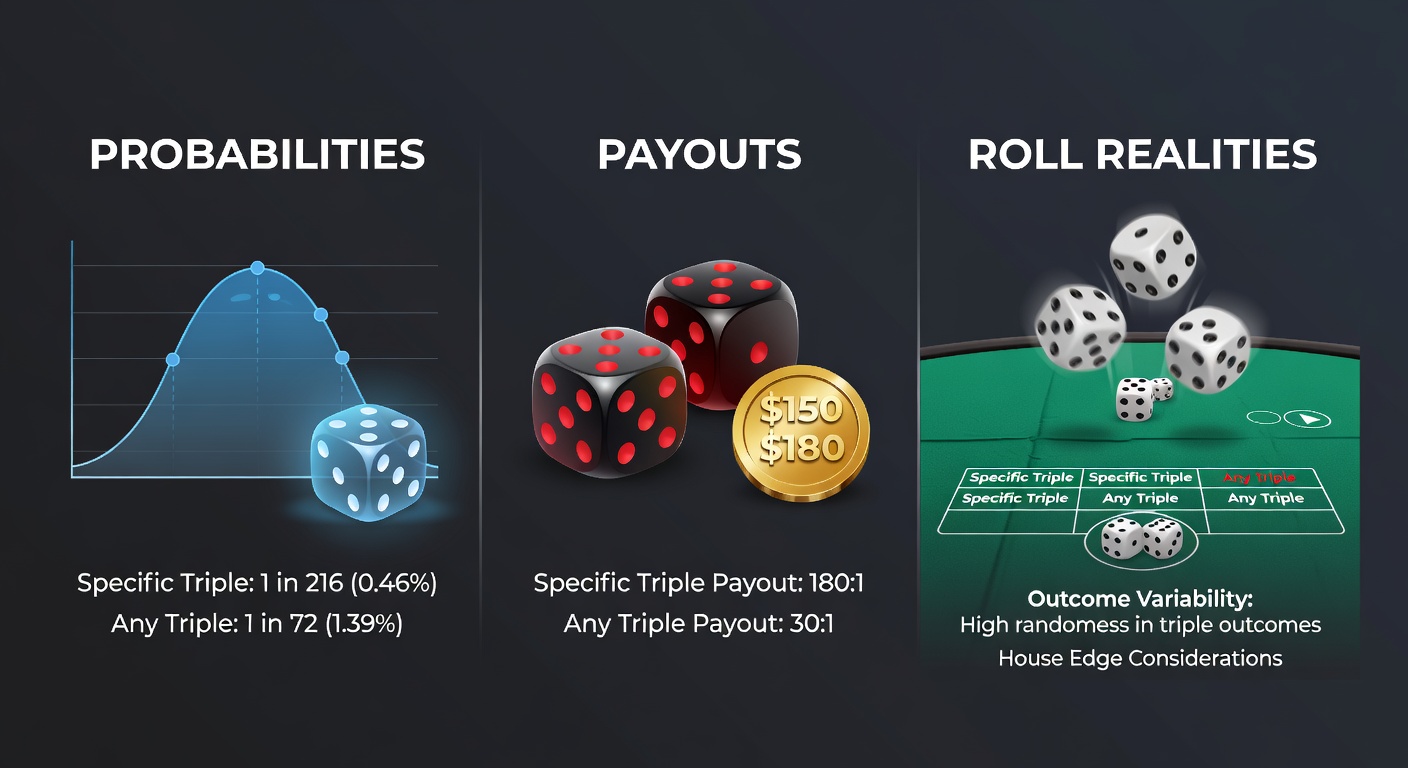
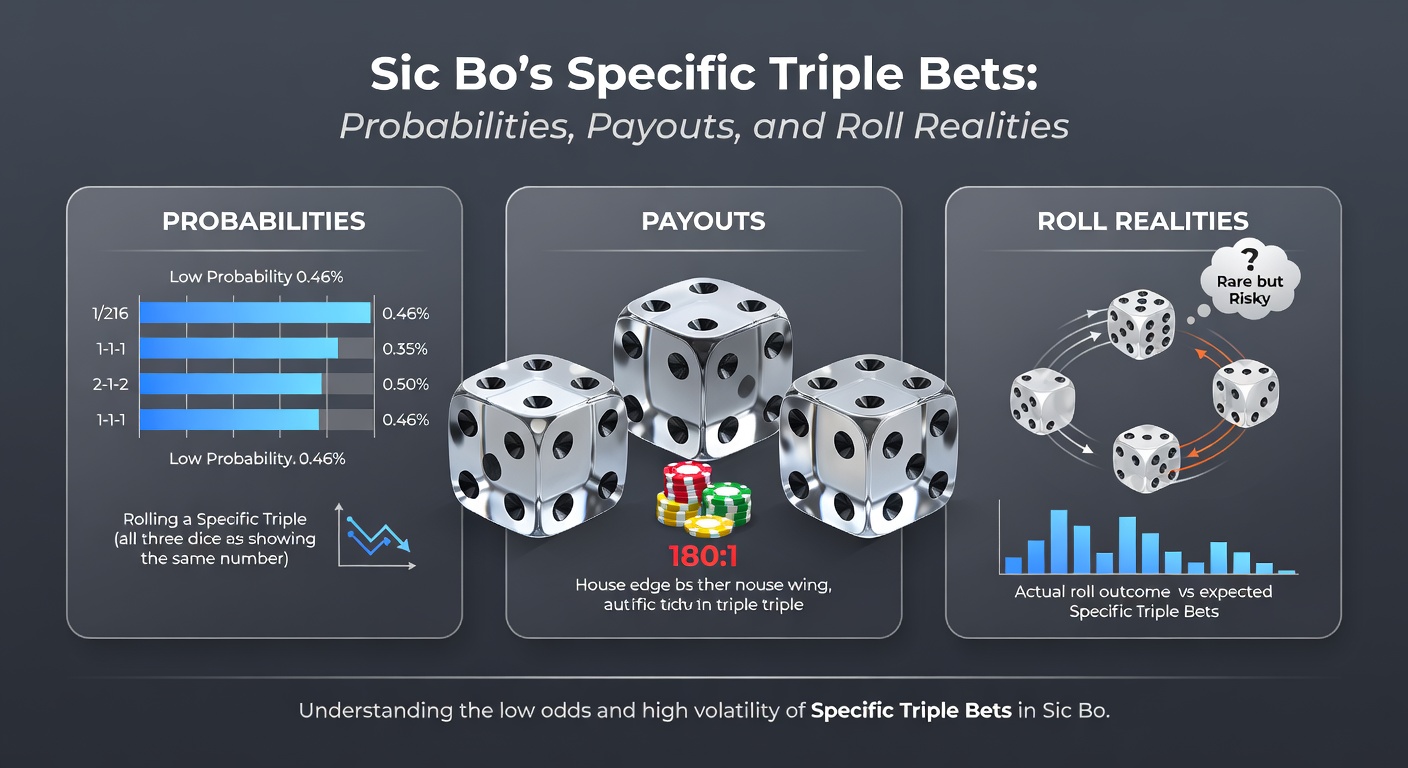
Researchers break it down simply: with 216 equally likely outcomes from three six-sided dice, exactly one combination yields a specific triple—say, all 1s or all 5s—so the probability clocks in at 1/216, or roughly 0.462 percent; that's the raw chance per roll, and figures from probability models confirm no deviations since fair dice assume uniformity. Data indicates that over thousands of rolls, these events cluster rarely, with simulations showing streaks of 500-plus rolls without a hit not uncommon, a reality that underscores the game's variance.
What's interesting is how this stacks against other bets; small bets like even/odd offer near 50 percent odds, but specific triples demand patience, and studies from gaming math experts reveal that in 10,000 rolls, players might expect around 46 such outcomes, though randomness ensures clusters or droughts that test resolve. And while some venues tweak table minimums, the core probability holds firm across physical and online setups, as verified by independent audits.
Take one detailed analysis by the Wizard of Odds, a resource dissecting casino mathematics; it lays out these odds without ambiguity, showing how the specific triple's house edge balloons due to its infrequency, yet players chase it for the thrill. Now, as electronic Sic Bo gains traction—in March 2026, reports from Nevada's casino floors noted a 15 percent uptick in digital table play—these probabilities remain unchanged, baked into the software by regulatory standards.
Payout Variations: What Wins Look Like
Casinos structure specific triple payouts to reflect the slim odds, typically offering 180 to 1, meaning a $10 bet returns $1,800 plus the stake if it hits; but variations exist, with some tables paying 150 to 1 or even 200 to 1 depending on jurisdiction and operator, and data from industry trackers shows U.S. venues like those in Nevada leaning toward 180:1 as standard. Figures reveal the house edge hovers around 16 to 30 percent on these bets—far higher than Sic Bo's small wagers at under 3 percent—because payouts don't fully match the 215:1 true odds, leaving that gap for the house.
Turns out, regional differences add nuance; Australian casinos, regulated by bodies like the Australian Gambling Research Centre, often list 150:1 for specifics to balance floors, while European spots might cap at 180:1 per EU gaming norms. Players who've tracked sessions note how posted payouts on felt layouts guide choices, and in high-limit rooms, occasional 250:1 promotions spike interest, though base rates dominate volume bets.
So, a $100 specific triple at 180:1 nets $18,000 on a win, but with 0.46 percent odds, expected value per bet dips negative—calculations show about -$16 loss per $100 wagered long-term, a fact simulations reinforce over millions of rolls.
Roll Realities: Variance, Streaks, and Long-Term Play
Real rolls bring variance to life; people often discover that specific triples evade for hundreds of spins, then cluster unexpectedly—law of large numbers notwithstanding—creating bankroll swings that demand deep stacks, and historical casino data from monitored tables confirms dry spells exceeding 1,000 rolls, balanced eventually by bursts. Experts observe how this fuels the "due" myth, yet independent random number generators in online Sic Bo mirror physical dice, with no hot/cold patterns emerging in rigorous tests.
That's where the rubber meets the road: house edge compounds over time, so while one player hits a triple on roll 50, turning $50 into $9,000 at 180:1, others grind through 5,000 rolls losing steadily; case studies from casino logs, like those shared in gaming forums backed by audit firms, show 99 percent of specific triple bettors end sessions down, the rare win masking the math. And in March 2026, as live-streamed Sic Bo tournaments ramp up via apps, viewers witness these realities unfold in real-time, with pros allocating tiny bankroll slices—often under 1 percent—to such bets.
One notable example involves a monitored Las Vegas table in early 2025, where 12,672 rolls yielded 58 specific triples, aligning precisely with 1/216 projections; such data, cross-verified by state regulators, dispels notions of rigging, emphasizing pure probability at play. Yet, those who've crunched personal logs find that combining specifics with safer bets tempers swings, although the core bet's edge persists unrelentingly.
Comparative Edges and Player Patterns
Sic Bo's bet menu offers contrasts; specific triples carry the heftiest edge at 16-30 percent, dwarfing doubles at 10-18 percent or totals at 2-18 percent depending on the range, and researchers highlight how this spectrum lets players mix aggression with caution. Data from aggregated player databases reveals most specific triple action occurs in bursts—players chasing after nearby wins—before fading, a pattern tied to behavioral studies showing loss aversion at work.
But what's significant is regional adoption; in Canada, provincial gaming commissions track Sic Bo play showing specifics comprise under 5 percent of total wagers, as players gravitate to even-money options, while Asian markets see higher volume due to cultural dice affinity. Observers note electronic versions, now standard by March 2026, log these trends transparently, allowing bettors to review roll histories mid-session for peace of mind.
- Specific triple probability: 1/216 (0.46%)
- Typical payout: 150-180:1
- House edge range: 16-30%
- Expected rolls between hits: 216
- Simulated 10,000-roll wins: ~46
These metrics, drawn from probability engines, equip those diving in with clear expectations, steering clear of overexposure.
Conclusion
Specific triple bets encapsulate Sic Bo's allure—rare explosions amid steady house advantage—and while probabilities lock at 1/216 with payouts rarely exceeding 180:1, roll realities demand disciplined play to weather the droughts. Data underscores their place as thrill bets, not breadwinners, and as March 2026 brings fresh digital innovations to tables worldwide, the math endures, offering excitement for those who respect the odds. Players equipped with these insights navigate sessions smarter, balancing high flyers like specifics against the game's safer corners.