Strategic Mapping of Decision Trees in Video Poker Using Paytable Configurations
Hugo Klein · Aug 13, 2026

Strategic Mapping of Decision Trees in Video Poker Using Paytable Configurations
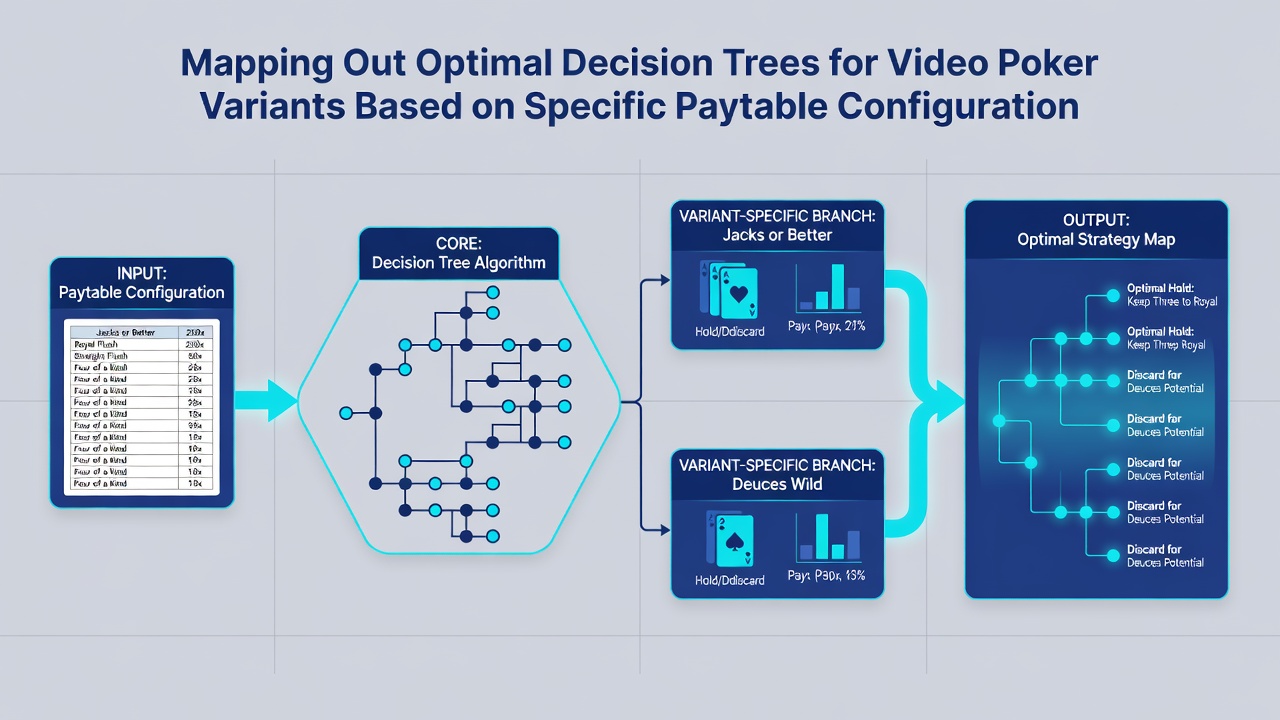
Video poker variants rely on precise decision trees that players construct around each unique paytable structure, and these trees emerge from exhaustive expected value calculations applied to every possible hand combination. Researchers in gaming mathematics have mapped these trees for games like Jacks or Better, Deuces Wild, and Double Bonus Poker, where the paytable dictates the exact ranking of draws such as holding two high cards versus pursuing a flush draw.
Data from regulatory testing labs shows that optimal trees shift dramatically when paytables change even by small increments, for instance when the payout for a full house drops from 9 coins to 8 coins per unit bet. In such cases the tree reorders priorities, moving certain three-of-a-kind holdings ahead of suited connectors that previously carried higher expected value.
Core Components of Paytable-Driven Decision Trees
Each tree begins with an initial five-card evaluation followed by branches that represent every feasible hold-or-discard choice, and each branch terminates in a calculated expected value derived from the specific paytable in use. Analysts at the University of Nevada, Reno have documented how these calculations incorporate the exact frequencies of royal flushes, straight flushes, and four-of-a-kind combinations listed on the machine's pay schedule.
Paytable configurations also determine secondary branches that account for partial draws, such as four cards to a royal versus three cards to a straight flush, and the tree assigns numerical values to these options based on remaining deck composition. Observers note that machines with progressive jackpots introduce additional nodes where the decision tree weighs the progressive increment against the base game return.
Variant-Specific Tree Construction
Jacks or Better trees emphasize retention of high pairs and suited aces when the paytable awards 800 coins for a royal flush, whereas Deuces Wild trees expand branches to include wild-card substitutions that alter every hand ranking. Studies published by the Canadian Institute for Gaming Research indicate that Deuces Wild decision trees contain roughly 40 percent more terminal nodes than standard Jacks or Better trees because wild cards multiply the possible outcomes for each initial draw.
Bonus Poker variants require separate trees that elevate the value of four aces or four twos through fours when those hands receive bonus multipliers, and the mapping process recalculates every path whenever the bonus thresholds change. Those who have examined large sample databases report that even a one-coin difference in the payout for a straight can reorder multiple early branches in the tree.
Computational Tools and August 2026 Developments
Software packages that generate these trees now run on standard gaming hardware, allowing casino operators to verify machine compliance before deployment. In August 2026 several manufacturers released updated simulation suites that incorporate real-time paytable scanning, and these tools automatically flag branches where player decisions deviate from optimal expected value by more than 0.05 percent.
Regulatory bodies such as the Nevada Gaming Control Board require operators to maintain documented decision trees for every video poker model on the floor, and the documentation must reference the exact paytable version installed on each machine. Industry reports from the European Gaming and Betting Association show that similar verification protocols have been adopted across multiple jurisdictions to ensure consistent player information.
Practical Application Across Casino Floors
Casino floor managers apply these mapped trees when selecting which paytable variants to install in high-traffic areas, and the selection process weighs the house edge that results from each configuration against player retention data collected over thousands of hands. One documented case revealed that switching from a 9/6 Jacks or Better paytable to an 8/5 version required complete revision of 17 primary branches in the decision tree, shifting the overall return by 1.8 percent.
Training materials distributed by gaming associations now include simplified tree diagrams that highlight the top five hold decisions for each common paytable, and these materials help staff explain machine behavior to players who request clarification on optimal strategy.
Conclusion
Decision tree construction for video poker remains a precise exercise in applied probability that depends entirely on the numerical values listed in each paytable. Continued refinement of computational methods ensures that operators and analysts can generate accurate trees for any new variant introduced to the market, maintaining transparency around expected returns across all configurations.